
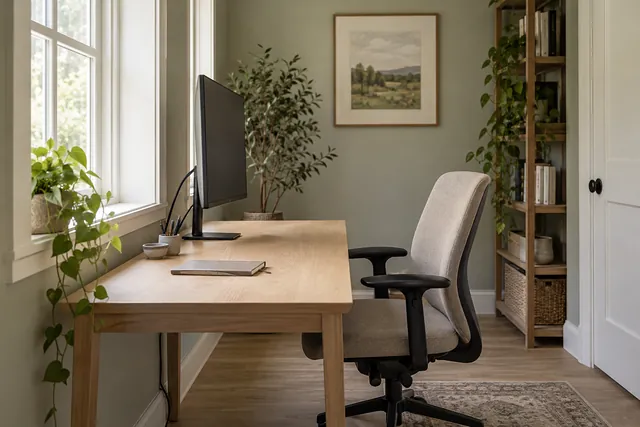
Move the screen before adding more decor
Use what I own · Practical

Styling reference. Check the arrangement and measurements in your room.
Home office · Scandinavian · Complete room scheme
A home office with comfortable working light, a clear close-down routine and a background that belongs in the home.
Download Pin image · 1000 × 1500 JPEG
The starting point
Keep a desk and chair that already support your work. Retain the useful shelf and the computer setup before adding decorative storage.
Use light wood and plain boxes to relate the work area to the home. A single dark task light gives definition; do not add open storage just to fill a wall.
This is a complete design direction to adapt, rather than a shopping list to copy. Start by listing the room’s actual jobs, the pieces that must stay and the constraints that cannot move. The example coordinates those decisions; it does not establish a result in your home.
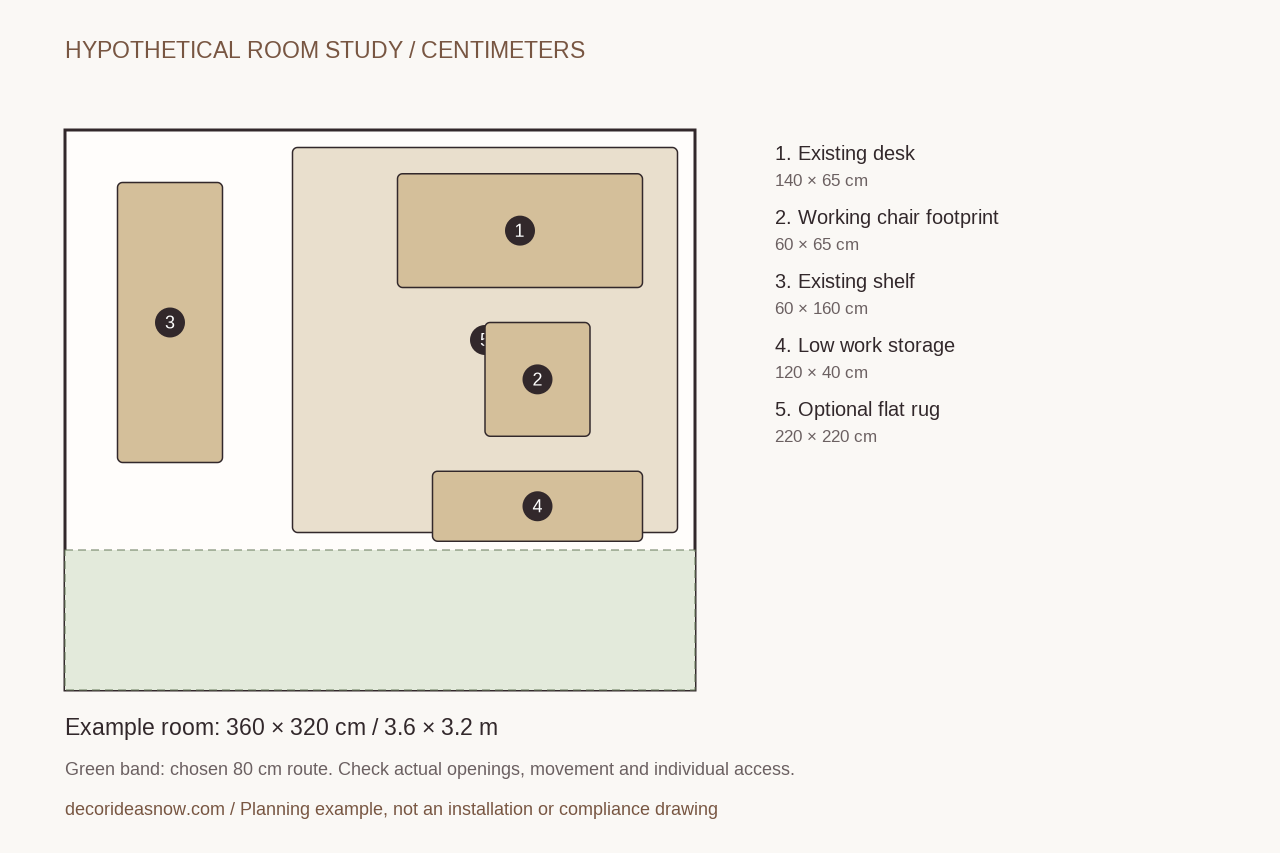
The working chair is shown pulled away from a 140 × 65 cm desk. The lower 80 cm band remains free of furniture. Chair rolling distance and storage-door travel must be checked in person. Move or remove the low storage if it interrupts either movement.
| Item | Width × depth | Left / top |
|---|---|---|
| 1. Existing desk | 140 × 65 cm 55.1 × 25.6 in | 190 / 25 cm |
| 2. Working chair footprint | 60 × 65 cm 23.6 × 25.6 in | 240 / 110 cm |
| 3. Existing shelf | 60 × 160 cm 23.6 × 63.0 in | 30 / 30 cm |
| 4. Low work storage | 120 × 40 cm 47.2 × 15.7 in | 210 / 195 cm |
| 5. Optional flat rug | 220 × 220 cm 86.6 × 86.6 in | 130 / 10 cm |
Rectangles check only footprints, room boundaries and the chosen route. Door swings, working space, electrical and plumbing zones, structural loads and individual access needs require separate checks.
#eeece4#d4bf9a#899ca9#aaada8#343b3bThese hex values describe screen relationships, not paint or fabric product codes. Compare physical samples with the furniture and floor you are keeping, under the light you actually use.
| Role | Direction | Check before choosing |
|---|---|---|
| Main surface | Off-white direction; retain sound existing finishes | Test a physical sample in the actual light; a screen swatch is not a product match. |
| Furniture | Slate blue or the compatible pieces you already own | Confirm actual dimensions, stability, care and any required furniture anchoring. |
| Textile | Birch with a small felt grey detail | Use one washable tray or organizing box for cables and papers. Clear and wipe the pale work surface at the end of a test week. |
| Accent | Black used sparingly in practical pieces | Try one sample or borrowed object before buying a coordinated set. |
Turn the screen side-on to the window, then check late-afternoon glare on pale surfaces. Aim the desk lamp at paper rather than glass.
Use one washable tray or organizing box for cables and papers. Clear and wipe the pale work surface at the end of a test week.
Test glare and where the work kit will close before buying a shelf. Spend on a controllable light if your existing one cannot serve paper and screen work.
| Priority | Allowance | Existing-first alternative |
|---|---|---|
| Task lighting | USD 170 | Turn the screen side-on to the window, then check late-afternoon glare on pale surfaces. Aim the desk lamp at paper rather than glass. |
| Work storage allowance | USD 212 | Use one portable work box in a shared room and limit exposed shelves to objects you reach during a normal session. |
| Chair adjustment / repair | USD 255 | Use one portable work box in a shared room and limit exposed shelves to objects you reach during a normal session. |
| Window / glare allowance | USD 128 | Test glare and where the work kit will close before buying a shelf. Spend on a controllable light if your existing one cannot serve paper and screen work. |
| Cable management and samples | USD 85 | Test glare and where the work kit will close before buying a shelf. Spend on a controllable light if your existing one cannot serve paper and screen work. |
| Uncommitted reserve | USD 150 | 15% retained for unresolved costs; increase it if your own quotes require it. |
| Total scenario | USD 1,000 | Replace every allowance with actual quantities, delivery, installation and verified quotes. |
For a no-purchase start, spend nothing on this scenario yet: rearrange the pieces you already own, borrow a sample and test the first step. For a staged update, price the highest priority first and defer the decorative layers. A larger allowance should improve fit, durability or function; it does not require buying more objects.
Use the budget allocator for your own total · Record real quotes in your shopping plan
Finish a full work session and close down the desk without using the adjacent room for temporary storage. Record openings and the complete furniture footprints. Tape the proposed positions without buying anything.
Test glare and where the work kit will close before buying a shelf. Spend on a controllable light if your existing one cannot serve paper and screen work. Borrow a light or textile where possible. Note what improves and what becomes harder.
Turn the screen side-on to the window, then check late-afternoon glare on pale surfaces. Aim the desk lamp at paper rather than glass. Keep the change only if daily use supports it, then replace allowances with current quotes and choose one next action.
Use one portable work box in a shared room and limit exposed shelves to objects you reach during a normal session.
These checks are part of your decision, not evidence that this concept has been built or tested. Retain an existing arrangement when it works better for the room’s people, access or budget.
Adding this scheme fills only blank brief details and adds its references. Your current notes, selected main image and older shopping plan stay in place. You can review the proposed addition before saving it.
A light Scandinavian office that can close down at five
https://decorideasnow.com/schemes/scandinavian-home-office/
HYPOTHETICAL ROOM SCHEME
A home office with comfortable working light, a clear close-down routine and a background that belongs in the home.
KEEP: Keep a desk and chair that already support your work. Retain the useful shelf and the computer setup before adding decorative storage.
STYLE: Scandinavian
COLORS: Off-white, Birch, Slate blue, Felt grey, Black
EXAMPLE ROOM: 360 × 320 cm
The working chair is shown pulled away from a 140 × 65 cm desk. The lower 80 cm band remains free of furniture. Chair rolling distance and storage-door travel must be checked in person. Move or remove the low storage if it interrupts either movement.
LIGHT: Turn the screen side-on to the window, then check late-afternoon glare on pale surfaces. Aim the desk lamp at paper rather than glass.
BUDGET: Illustrative USD 1,000 total, including USD 150 reserve. Planning allowances, not current product prices or quotes.
ALLOWANCES: Task lighting: USD 170; Work storage allowance: USD 212; Chair adjustment / repair: USD 255; Window / glare allowance: USD 128; Cable management and samples: USD 85
FURNITURE: Existing desk: 140 × 65 cm at 190 / 25 cm; Working chair footprint: 60 × 65 cm at 240 / 110 cm; Existing shelf: 60 × 160 cm at 30 / 30 cm; Low work storage: 120 × 40 cm at 210 / 195 cm; Optional flat rug: 220 × 220 cm at 130 / 10 cm
MATERIALS: Off-white direction; retain sound existing finishes — Test a physical sample in the actual light; a screen swatch is not a product match.; Slate blue or the compatible pieces you already own — Confirm actual dimensions, stability, care and any required furniture anchoring.; Birch with a small felt grey detail — Use one washable tray or organizing box for cables and papers. Clear and wipe the pale work surface at the end of a test week.; Black used sparingly in practical pieces — Try one sample or borrowed object before buying a coordinated set.
PRIORITIES: Test glare and where the work kit will close before buying a shelf. Spend on a controllable light if your existing one cannot serve paper and screen work.
FIRST CHECKS: Finish a full work session and close down the desk without using the adjacent room for temporary storage. Test glare and where the work kit will close before buying a shelf. Spend on a controllable light if your existing one cannot serve paper and screen work. Turn the screen side-on to the window, then check late-afternoon glare on pale surfaces. Aim the desk lamp at paper rather than glass.
ADAPT: Use one portable work box in a shared room and limit exposed shelves to objects you reach during a normal session.
CARE: Use one washable tray or organizing box for cables and papers. Clear and wipe the pale work surface at the end of a test week.
Verify your actual dimensions, product care, fixing instructions and quotes.
A home office that belongs in your home · Plan your colors · Set buying priorities
The scheme, dimensions, allocations and palette are original editorial examples. Product prices and professional review are not claimed. CPSC furniture tip-over guidance supports following the furniture maker’s anchoring instructions. Our editorial approach distinguishes illustration from real-world evidence.
These separate concept references explain an individual decision; they are not additional photographs of the same room.
Use what I own · Practical

Use what I own · Minimal