Your starting point
Compare the sofa and floor as two separate colors. Add a textile or rug that makes their edges easy to see, then repeat one accent in a small detail before deciding on wall paint.
Put the idea to work

Read the brown before choosing a complement
Try a neutral cloth behind the cushion and notice whether the sofa leans red, orange, taupe or near black. Set the cloth next to the floor to expose a mismatch. Take the largest gap first. A sofa that disappears into a dark floor can benefit from a lighter plane beneath it.
Try a palette around the furniture you keep
Start by combining a backdrop, a bridge material and a smaller accent. Use physical samples at the scales you would actually see.
| Sofa and floor | Backdrop and bridge | Small accent |
|---|---|---|
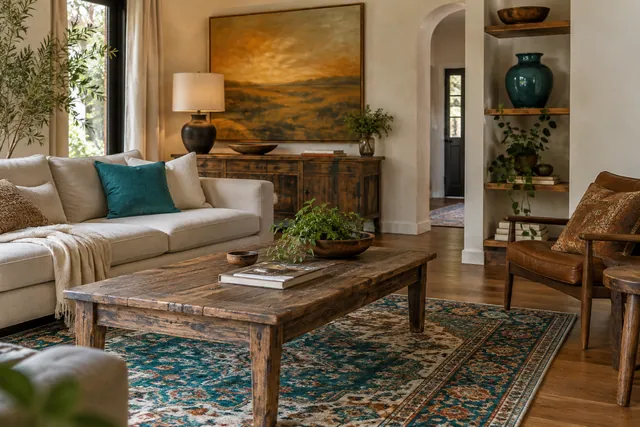
| Cognac leather and dark oak | Warm ivory wall and oatmeal flatweave | Soft indigo |
| Chocolate fabric and red-toned wood | Natural linen and a muted tan with a clear edge | Moss green |
| Cool taupe and smoked timber | Chalk backdrop with medium-value faded blue textile | Aged brass |
Use texture for a bridge
A woven flatweave brings small tonal changes near the floor. Linen or plain cotton can take some visual weight off a dark sofa. If the floor and sofa already have prominent texture, compare a quieter rug against a busy one with tape-sized samples.
Let the largest surface lead
Lay warm and cool textiles beside the sofa at different times of day. Try moving the accent from the cushion to artwork or a lampshade when it looks disconnected. Keep one instance at eye level and see whether that is enough.
Test the full seating group
Tape the rug footprint and check the door and seats before finalizing the color. Set the original lamps back where you use them and look from the next room in the evening. Keep or change the wall sample only after the textile relationship makes sense.
Your practical checklist
Tick these as you go. Choices are saved in this browser when storage is available.
Common questions
Does a brown sofa need white walls?
No. Compare light neutrals and deeper colors beside the sofa. Look for comfortable contrast around the main seat.
Can two brown woods share a room?
Yes. Repeat a finish or contrast the two deliberately with a simpler textile. Check the actual pieces side by side.
What is the quickest change to try?
Move a light textile or borrowed rug near the front of the sofa. Observe how the edges read before shopping.
Sources & editorial approach
- Benjamin Moore: Paint & Color Samples — Using physical samples to compare colors under a room’s lighting. Our palette combinations are original styling suggestions, not product matches.
- IKEA Canada: A complete rug size guide — Furniture placement and dining-chair extension. Product sizes vary; our calculator uses an independently defined stock-size list.
Source review dates are listed in the source library. Advice and examples are our editorial synthesis; dimensions are starting points, not universal requirements. How we create our guides.